
Symptoms
- Two devices using NMEA as their time reference report time that differs by less than one second.
- The reported offset varies slightly between devices and may change over time.
- Both devices appear to be receiving valid NMEA time data.
Causes
- NMEA time is provided as a data message and does not include a precise timing marker that indicates the exact top of the second.
- Each device processes the NMEA message at a slightly different moment.
- Without a common pulse reference, devices cannot remain phase-aligned to the same second boundary.
When devices reference GPS/GNSS directly, they receive both a time message and a 1PPS signal. The 1PPS signal marks the top of the second and keeps devices tightly synchronized.
Troubleshooting steps
- Check whether the device outputting NMEA can also provide a pulse output.
- If a pulse is available, configure the device to align the NMEA input to the pulse input.
- If a pulse is not available, consider using GPS/GNSS as the primary reference for your setup.
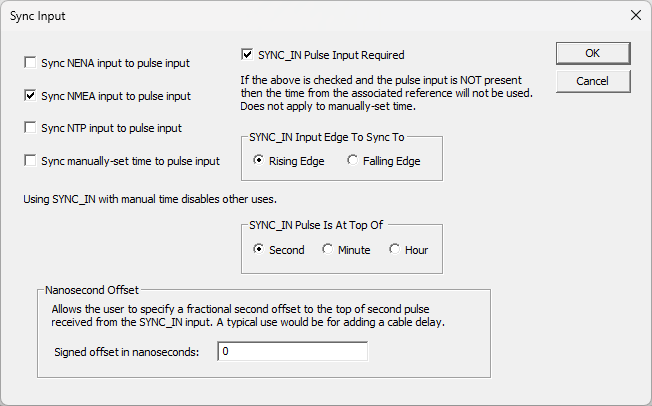
In WinDiscovery Device Settings, open Sync Input and enable Sync NMEA input to pulse input. This allows the NMEA input to stay aligned to the rising or falling edge of a pulse, and to the top of the second, minute, or hour as configured.
Related articles
Article ID: GMR-NMEA-001
KB Version: