
What happens when a reference is lost
When a device loses its external reference (for example GNSS, PTP, upstream NTP, or time code), it enters holdover and continues running on its internal oscillator. Depending on configuration, the device may also stop serving time outputs during the outage.
Oscillator discipline before holdover
While a suitable external reference is available, the device disciplines its internal oscillator to that reference. Sustained discipline helps establish the oscillator’s rate of drift so the device can better maintain time after reference loss. Acquiring GNSS lock does not necessarily mean the oscillator has reached its best long-term stability.
OCXO and rubidium oscillator options use temperature control and active compensation to reduce sensitivity to ambient changes compared with uncompensated oscillators. They still have finite drift in holdover. Performance depends on the oscillator option, prior disciplining, environment and outage duration.
For a holdover assessment, record the model and oscillator option, allow continuous operation on a valid reference, and compare timing error over the required outage period. Use the applicable product specification for acceptance limits; there is no single stabilization time or temperature-versus-drift figure that applies to every model.
Why time outputs may stop by default
During holdover, time accuracy can slowly drift. To prevent distributing time that may no longer meet accuracy requirements, many devices are configured to stop serving NTP, IRIG, or SMPTE outputs when the reference is lost. This behavior is expected and intentional.
Allowing time dissemination during outages
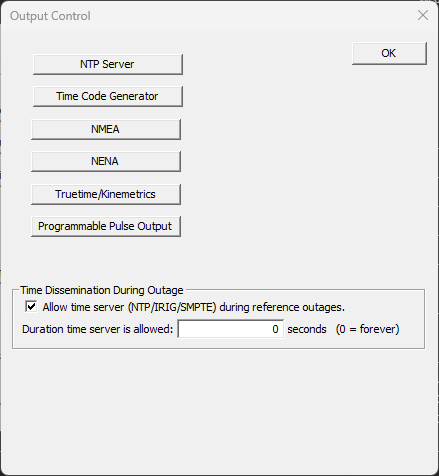
If your application requires time to continue being served during reference outages, enable Allow time server during reference outages in WinDiscovery:
WinDiscovery → Device Settings → Output Control
When enabled, the device will continue outputting time (NTP and supported time code outputs) even when no external reference is present.
Duration setting
The setting Duration time server is allowed controls how long the device continues serving time after reference loss.
- 0 seconds means forever
- Any non-zero value limits dissemination to that many seconds after the reference is lost
Use 0 only when the application can tolerate holdover for the full outage. A non-zero duration limits how long time is disseminated without an external reference.
Important considerations
- With dissemination enabled, the device serves time based on its internal oscillator during the outage.
- Status may show Unlocked or Holdover even though time is still being served.
- Confirm your application can tolerate holdover accuracy for the expected outage duration.
Output Control setting
Article ID: KB-TIME-OUTAGE-001
KB Version: